The church marked it’s 200th birthday in the year 2006. As part of the celebrations an exhibition was mounted and at the opening of the exhibition (on February 18th of that year), Dr. John Dolan gave a talk on the history of the church. A transcription of that talk is provided below.
Introduction
The whole of the area around Warrington was, from as far back as Saxon times, included in the ancient parish of Winwick – whose St.Oswald’s church was for many centuries the only church serving the parish and drew parishioners from many miles away for services and festivals. Later a chapel of ease was added at Christ Church, Croft. When Henry VIII ushered in the English Reformation, forming the Church of England, many who remained true to the Catholic faith were persecuted but Roman Catholicism kept going throughout the Reformation, and in our local area, was kept alive mainly in Catholic homes in Croft & Woolston – e.g. Southworth Hall. In 1662 the Act of Uniformity was passed which required all clergy to assent to the standard Book of Common Prayer – Christians who refused to conform to this law became known as ‘nonconformist’ or ‘dissenters’. At this time church attendance was compulsory – on pain of a fine. From 1678 onwards Risley & Croft dissenters were each fined 2 shillings for not attending Parish Church – these included the Monks and Bate families (only one of whom promised to start attending!)
In 1689 the Toleration Act was passed in Parliament and under its rules, it was permitted for non-conformists to worship freely and have their own meetings places and appoint their own preachers and teachers. Thomas Risley was one of the non-conformists in this area and he registered Richard Jackson’s barn at Croft as a meeting house. A chapel was then built around 1706-07 in Cross Lane – which, like many other chapels, had to be a distance away from the nearest town. This chapel became a place of non-conformist worship for people from a wide area and it drew many famous names – Matthew Henry whose Commentary of the Bible is still used today – preached there. During the 18th century the chapel absorbed Unitarian ideas and in 1838 the minister & trustees were removed by legal process in order to establish a Unitarian Chapel at Croft. Both of these chapels are now gone but the burial grounds associated with them remain. The Risley Presbyterian Chapel continues today as Thomas Risley Church, named after its original founder. So when Risley Independent Methodist Church appeared on the scene it was against a background of diverse religious activity, but at a time when the other Risley Chapel was grappling with its identity, one of the effects of this was that there was no evangelical witness.
Lorenzo Dow & the beginnings of Independent Methodism
The catalyst for change was Lorenzo Dow – an American preacher who was once a Methodist but had been disowned by them and was regarded as something of a maverick. Dow arrived in England in late 1805 to news of Lord Nelson’s victory at Trafalgar. Dow started preaching in Liverpool, where he met Peter Phillips of Warrington who invited Dow to his home. Dow made Phillips’ house his base for freelance evangelistic work in the North-West of England for most of 1806 and part of 1807. Dow kept a Journal (a very rare copy of which was shown in the talk) and it provides an invaluable record and first insight into the beginnings of this church.
A Covenant to pray for revival began early in 1806 under Dow, Phillips and Mr. Johnson and it is recorded that there were many converts. Early in the year his hearers were from surrounding villages, including Risley and this led to him getting an invitation to preach there (though the specific date is not known it was clearly between the beginning of the year and May from other entries in the journal.
Dow’s commitment to preaching was remarkable – his journal entry for Saturday, May 3rd, 1806 tells us that he spoke in Preston-brook in the evening then left for Warrington where he stayed the night. He spoke the next morning at Friars Green where about forty new members had joined them in his absence. In the afternoon he says “Thence to Risley where I found several had been set at liberty since I was there last.” In the evening he then went to Leigh and spoke to about two thousand people at the Methodist chapel. And all of this journeying was by foot! One other reference that year in November simply says he visited Risley “with great satisfaction”. Shortly after this he returned to America. He left at Risley a congregation of poor people living off the land in this (then) remote hamlet on the edges of Risley Moss who had acquired the nicknames Dowites or Ranters. Immediate support for this fledgling congregation came from Peter Phillips and other preachers from Friars Green who now supported the network of cottage meetings – of which there were four in the area North-East of Warrington. One was in Risley, one in Croft where a chapel was built before there was one here. That chapel was closed in 1837 and was taken over by the Wesleyans who also didn’t last long – but by a pleasing turn of events the Independent Methodist church is now there again in the form of the Olive Branch fellowship. The third was that in Culcheth (it is unclear whether or not that was a forerunner of Culcheth Church) and finally Lowton – this is not to be confused with the present Lowton I.M.Church but was based in the home of James Ashton, which was situated opposite St. Luke’s Church.
Hugh Bourne and the development of Risley’s early church
Unfortunately, unlike Lorenzo Dow, Peter Phillips never left a journal – so for the next stage in the story we must switch to another man, from beyond this locality, who played a great part in Risley I.M. Church’s history – and over a much longer period. Bourne’s journal gives further insights into the early beginnings of the church and names some of the people involved.
Hugh Bourne then aged 37, was a Wesleyan local preacher and Staffordshire carpenter, who had caused a stir by holding a Camp Meeting on Mow Cop. And by a pleasing turn of events, the person who had inspired and encouraged him to do so was Lorenzo Dow who he’d met at Congleton. So how did Bourne come to be connected with Risley?
In June 1807 he was present at the Independent Methodist Annual Conference which that year was held at Macclesfield. There he took up an invitation to visit the Quaker Methodists in Warrington and he stayed at the home of Peter Phillips. Notes in his journal state that he went to Risley “among a people raised up by Lorenzo Dow”. Furthermore he visited Risley numerous times over the coming years, sometimes staying for two or three weeks at a time.
Bourne was struck by the style of worship he encountered at Risley. He wrote in his journal entry of 23rd April 1809 that “We had a meeting at Risley – an exceedingly powerful time. … Here each one does that which is right in his own eyes. They stand, sit, kneel, pray, exhort &c. as they are moved. I was very fond of this way.” Note that this indicates that the worship was all very spontaneous and is typical of part of the independent character, associated with some early IM churches and possibly indicating the influence of the Quakers from Friars Green.
But Bourne’s affectionate view of the worship at Risley was not shared by all of his colleagues such as W. Clowes who said ‘ We went down to Risley and found a people very singular in their notions and manner of worship which we did not admire it at all.’ Others disapproved too – a record exists of a “Presbyterian minister at Risley [who] scoffed at Lorenzo and called him an impostor – but was struck blind & died soon after. He had not been a strict liver.”
Indeed the arrival of this new form of non-conformity was not welcomed by some staid Presbyterians (who were semi-Unitarian) at Risley – perhaps they felt that the community wasn’t big enough for both of them. It was not uncommon for groups such as this to suffer persecution. Hugh Bourne wrote “But they are dreadfully persecuted. Thomas Pilling was lamed in his arm dreadfully by a savage persecutor named Moscroft, but he took it quite patiently.” This seems to have continued at least until 1813 (that is for seven years after the church’s founding). It was recorded at that time that “persecution has raged, but now it seems in a measure kept under.”
Amongst the people Bourne mentions are: John Webb (class leader & later preacher), John Massey (stayed at his house), William Yates originally from Leigh, who later settled at Stockton Heath and who was a prodigy of Bourne who launched him into preaching ministry, Joseph Peers (from Culcheth), James Higginson (who lived at Moss Side), William Dickenson, Thomas Pilling, Alice Pilling, Ellen Massey, and the Whitter and Partington families.
Bourne soon realised that for all their enthusiasm, people’s Bible knowledge was poor. In August 1810 to remedy this, he ordered half a dozen New Testaments and if those were insufficient, they were to have a dozen. He purchased a Bible for Ellen Massey (on the thirteenth of June) and Thomas Eaton (of Stockton Heath) gave him money to buy one for John Webb, the class leader. On a later visit Bourne reported that he found Risley flourishing – “they have taken to the Scriptures”.
All this effort to improve the church’s Bible knowledge counteracted some of the more excitable aspects of revivalism (such as dreams and trances). In 1813 it is recorded that the class leader “John Webb is getting on exceedingly well, and I trust will be made very useful in this place. He said that he had lost much time in seeking after mystical notions; but he now found that the most useful things were quite plain – such as repentance, faith, holiness, &c. My heart rejoiced at hearing him so speak.” Unfortunately the report makes no reference to where the church met. But the first meeting is said to have been in a farm building, and the second was in the home of John Speakman, but even that had been demolished by the time story was recounted in 1906.
Bourne was eventually expelled as Wesleyan preacher for holding camp meetings – in 1811 he and others formed churches that wanted to link with him into denomination – and they named themselves Primitive Methodists. This change in the young denomination’s organisation created issues for Risley as they had support from both the Independent Methodist churches in Warrington and from visiting Primitive Methodist preachers – in fact Risley bears the distinction of being listed on the first ever Primitive Methodist plan and was the denomination’s most northerly outpost. The links with both Primitive and Independent Methodist churches mean that Risley ended up with a foot in both camps – and remained in that situation for the next forty years or so. The only source of information regarding the church’s activities at this time are the few circuit plans that remain in existence.
The plans are therefore an important indication of the church’s life during this period – in 1818 Risley appears on the Primitive Methodist plan. The earliest surviving Warrington I.M. plan is from 1824 and shows that the I.M. church at that time drew all of its preachers from within the I.M. circuit. The 1826 plan shows services at Risley being held at 10.30 am and 2.00 pm and in most cases the same preacher would take both services, probably having lunch at the home where the services took place. In the 1830s Risley disappears from the I.M. records and next appears in the Primitive Methodist records of the 1840s. Now the services were held at 2.00 pm and 6.00 pm. There was a quarterly collection and a quarterly lovefeast. The salaried ministers took turns at taking weekly meetings – and it is timely to remember that this church was once led by ministers paid for by its own and other local congregations and appointed by the P.M. Connexion. The church at this time had three local preachers in membership: Samuel Hatch, Samuel Turner, John Speakman.
The building of the first Risley chapel
In 1848 there was a great event; after forty-two years the congregation had a chapel! Hugh Bourne was invited to open it. By the 1840s he was the leader of a large denomination (the Primitive Methodists), and so was a figure of national stature but he nonetheless had a special regard and affection for Risley – forty years of fame & public acclaim never diminished or removed his love for Risley and he preached at the opening in 1848. The chapel was built by its own members which numbered thirty-five (although clearly there would have been many more in the congregation). The 1848 chapel (which we now refer to as the Old Chapel) was situated on Longcut Lane, later known as Lymm View. In September 1848 Bourne preached there for the last time – he was aged seventy-seven and he arrived via the (then) new railway station at Bury Lane (in Glazebury which was closed in 1958) and walked the four miles to Risley. On the Sunday afternoon he preached to children in the open air. The noted collection was £9.
Risley was said to be a ‘synonym for revival and revival habits’. Mounfield in 1906 could quote an old Methodist who could remember the church fifty years before (i.e. in the 1850s) who said: “Most Christians can praise God in song and prayer, but at Risley they took David’s advice and praised Him in the dance. On Sunday nights after preaching they used to clear away the forms, stand in a circle with arms linked, and jump for joy. This is no exaggeration as many can testify. The wreckage of the seats is said to have been a very ordinary part of the routine of the society… and a survey of the wreckage was said to form a very accurate index of the value of the meeting, as good meetings were understood at Risley.”
At this stage it is worth pausing from the actual history of Risley and give some explanation and description of some of the events and procedures of the Primitive Methodist and Independent Methodist churches. We have already mentioned the Camp Meetings at Mow Cop – these were open air meetings with speakers. They would draw people from far and wide and were big occasions in the calendar. The meetings, being outside and in the days before amplification, relied on each preacher standing in a certain area and the crowds milled about, listening to each speaker in turn, till he had finished his sermon, and then moving to hear the next. Locally these were held in Orchard Street in Fearnhead right up until 1934 where an organ loaned by Mrs. Higham was used. That year it was decided that the following year’s event should be held indoors at the church but that indoor event in 1936 proved to be the last of these annual meetings.
Another regular feature of church events were Lovefeasts – which were fellowship meals in which when water and bread (possibly currant bread) was passed around and people gave testimonies. Often a loving cup was used – a two handled, decorated mug – from which the drink was shared. These lovefeasts were often organized on a circuit basis with each member church taking it in turn to host the meal.
Class tickets were issued within the church to help organize the teaching of the Word within the church. Each church was divided into classes each with a leader – the classes met weekly and shared their spiritual progress or lack of it to each other.
Tickets were issued for renewal of membership each quarter and the subscriptions for the church and/or circuit were collected by the leader. Often one of the appointed ministers would come to visit the churches in order to give out the new tickets
A census has been taken in England & Wales for over two hundred years now (the first official one was in 1801). It is taken every ten years and has become more detailed and informative as time has gone on. In 1841 a census was also started to take information about church attendance. The 1851 census includes Risley for the first time. A number of things are clear from the entry: the chapel (the old chapel at Risley) was named the Prosperity Chapel. It was listed as a Primitive Methodist church and was built in 1848. The attendance at the afternoon service was forty–eight people and in the evening service, forty-four.
What the 1848 census doesn’t tell us about is the Sunday School. But Sunday Schools were often separate entities from the actual church – and of course it is also possible that the children of the church members may have attended another Sunday School in the area if there was one, for example at the Presbyterian chapel in Croft Parish. It is important to note that up to the late nineteenth century Sunday Schools were not places purely for Christian instruction, they primarily did what day schools do now i.e. they were places of more general education where children could learn the ‘3 Rs’.
It was soon after this time that there was a local breach within the Primitive Methodist church and that seems to be the point at which Risley moved towards Independent Methodism. The events surrounded George Herod, a local Primitive Methodist minister who in the early 1850s was in charge of a church in Old Road, Latchford as well as being the leader of the Risley church and a number of others. He appears to have been very authoritarian and caused a split in his Latchford congregation on account of pew rents. These rents were charged in order to gain income for the churches, with people renting, perhaps to reserve for their family, a particular pew in the church. In order to ensure that not all pews were rented out to those who could afford he money, a number of pews were reserved in each church for the poor. Mr.Herod was convinced that a large number of people were depriving the church of income by pretending to be too poor to pay the pew rent and sitting in the pews reserved for the deserving poor when they were able, really, to afford to sit in the rentable pews. In fact he became so convinced that he decided to make life very uncomfortable for those in the rent-free pews and one day sawed off the back-rests from those free seats. Many people within the church in Latchford were unhappy about this and formed a breakaway group that became the present day Buckley Street Church -although it did not join the Independent Methodists until many years later. Incidentally the Buckley Street Church’s noticeboard included the legend ‘All seats free’ as a mark of its principles.
These strange events had an unsettling effect at Risley and by1854 the last remaining Primitive Methodist members refused to re-apply for their class tickets – and the Risley church made its last appearance on the Primitive Methodist plan that year.
The Early Years of the Twentieth Century
The New Chapel project
Life at the New Chapel
The early years of the new century saw a keen sense of mission with three separate Evangelistic campaigns recorded between 1905 and 1911. The sense of a strong evangelistic motivation in the church is clear with statements such as ‘We have had the unbounded pleasure of seeing souls won for Christ’ recorded. The periods also saw the instigation of open air services on Sundays as well as Bible classes for young men that were held throughout year. Children’s and women’s services were well attended. The revivalist spirit was not only felt in Risley, the Welsh revival was in full flow in this period and its effects had started to spread into parts of North West England and this encouragement, that the church was part of a movement of God that extended far beyond its own area must have been one of the reasons that church was able to enjoy these fruitful years, despite the rapid falling away of the revival after 1911. But the general confidence throughout the country in this area, in all walks of life was felt as strongly here as anywhere, and it is possible that this confidence was one of the reasons that the church made its next great step forward.
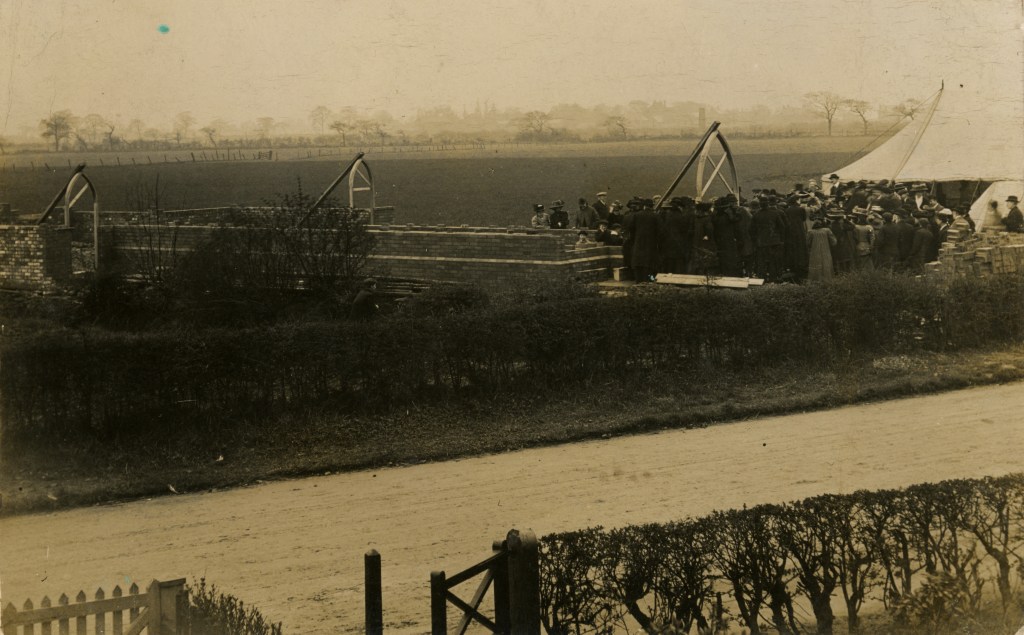
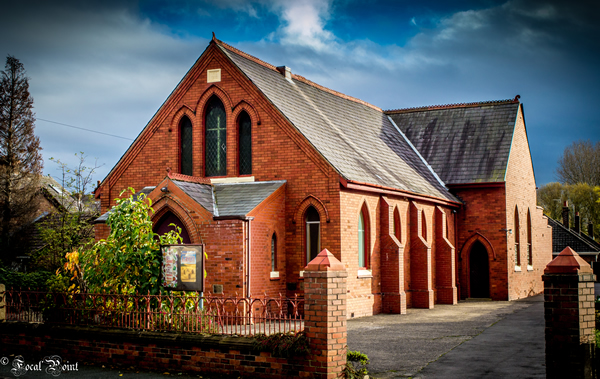
On 29th May 1904 a decision was taken to start working towards the funding of the building of new chapel and this decision generated a great deal of interest among the members which at this time had a steadily growing contingent in the village of Fearnhead rather than the area around Risley where the then Chapel was built. It was agreed that a plot of land be purchased for a maximum amount of £125 and a chapel built for maximum of £1,000. As it happened, an approach was made to Edward Gandy, a local resident who owned some land on Fearnhead Lane in Fearnhead that was thought suitable for the building of the new chapel. Mr.Gandy gave the land free of charge. Arthur Mounfield was engaged to draw the architectural plans and in this way Risley followed something of a pattern as Mr.Mounfield had already designed several other chapels in the area, Stockton Heath I.M being one of them.
The work of Fundraising was set to with enthusiasm and purpose. Tea meetings, services of song by the married men of the congregation, a Ladies’ concert, a sale of work all were used to help finance the new build. In 1906 a Centenary bazaar took place to mark the 100th anniversary of the church and in 1910 a Savings Bank was established, all interest on the savings was put towards the church. But despite all of these great efforts by the time the building was due to start, there were insufficient funds available to complete the building.
A further event was planned for 1910 to try and remedy this shortfall in the funding and what a success it turned out to be! A stonelaying ceremony was organised. This was a regular occurrence at new church buildings and was often the occasion of a larger celebration than the actual opening of the church building itself. At the new Risley Chapel the event was so large that a marquee that was able to accommodate three hundred and fifty attendees was hired for the day and two hundred tickets were printed. Tea was available at nine pence a time. But the real money maker was the laying of the stones itself. People were able to sponsor a stone at a charge of two pounds and ten shillings and twenty people subscribed to this scheme proving fifty pounds in total. Some made extra donations to have their names carved into the stones (these can still be seen on the outside of the chapel near the main door). Children’s names could be added at half price. In the end the amount raised was large enough to enable the church to pay for the majority of the work and take out a mortgage for the £300 remaining.
One way that additional funds were raised was to sell the old chapel and its contents. But this proved easier sad than done and three years after the opening of the new chapel, the old one, a mile down the road in Risley, was still unsold and in 1914 the matter of the sale was put into the hands of the church elders. In 1913 they advertised the old building in the Warrington Guardian for £35. It was sold eventually to a Mr.Tweedale for £50, in the same deal Joseph Hinmens took over the ground rent which was set at eight shillings per annum.
Of course, most activities would carry over from the old chapel but in the new and better facilities the church was able to carry out new activities and some of these are recorded in the minutes of the church’s business meeting:
- The church was registered for marriages in 1912.
- A Poor Fund was established.
- Individual communion cups were purchased.
In 1912 the church took part in the Walking Day and field day, possibly for the first time. Decorated carts and lorries were added to the procession. It is a moot point whether this only began with the move to Fearnhead. There is some confusion in the records concerning the invitation to take part in the procession. The church had considered having its own walk but in 1913 it walked in the main procession and the Brick Street I.M. brass band played for a fee of £4.
In 1916 there was a Christmas Day tea for infants followed by another for adults. A Concert was performed for which the children practiced parts for weeks in advance. This was not an unusual occurrence, but was perhaps more typical of churches in urban areas where often the special day would begin with a free breakfast for the poor children of the neighbourhood. The festivities came to a rapid close though as there was a Church business meeting on Boxing Day.
The Church agreed that they would support one of its members, Robert Bold, when he was invited to preach at the Presbyterian Chapel which further indicates that relations were evidently cordial between the two congregations.
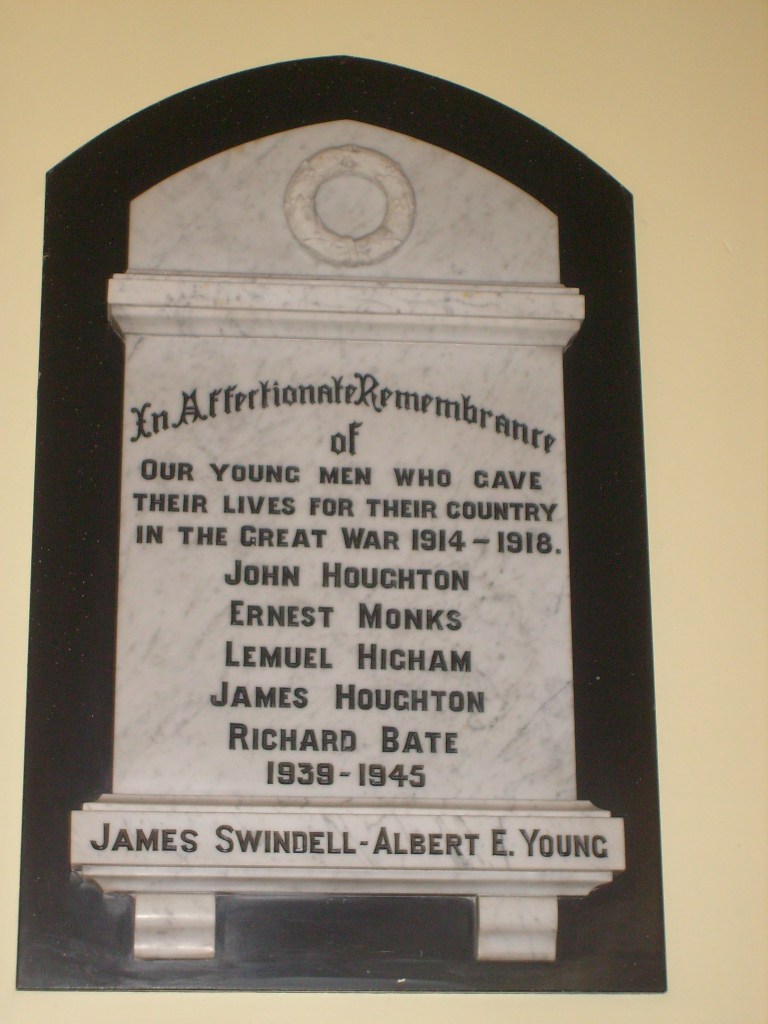
In 1914 the advent of World War I saw the church embark on a series of events such as a concert for soldiers to help contribute to the local war fund. The church suffered a number of casualties, as it did later in World War II, and these are recorded on the war memorial which is mounted on the east wall inside the chapel. The First World War had a huge impact on all churches – many never resumed their attendance after the war due to the number of casualties suffered or because of indifference. The minutes from the business meeting suggest that the lack of progress by the church was deplored and, indeed, it was noted that the attendance at the Morning services was declining, although there was a slight increase in the evening service.
But there were positives to emerge from this period. The period of the First World War saw the Women’s Auxillary formed, an event which would have tied the church more closely to the Independent Methodist as the WA was a Connexion-wide body that was enjoying great popularity at this time. Soon afterwards the Christian Endeavour society was instigated at Risley, The first reference to its activities was in 1922 but there are suggestions that it had been active in the church earlier than that. Both groups entailed involvement with other churches – the ladies went to rallies, Endeavourers went to conventions both locally and further afield. Both would be training grounds for potential leaders and speakers who first found their feet in these organisations.
Because of its rural aspect, Risley became a popular venue for other churches wanting to go somewhere for a field day, especially after Warrington Walking Day and churches such as Friars Green, Kent St, Buckley St, Emmanuel all came at one time or another to make use of the facilities available in the new chapel and its surrounding fields. The wider Warrington CE Union had a regular programme of events too with garden fetes and sales becoming fixtures in the calendar. However despite the increased level of activities in a social sense, on the Evangelistic front there is less happening than in the pre-War years. So much so that in 1927 Henry Barrett, the then Connexional president, made every meeting of his round of church visits an evangelistic meeting and his appearance at Risley saw a great response with twenty-seven converts recorded. Following Mr.Barrett’s visit the church then held a special service of welcome for the new converts. Furthermore, due to the success of his first visit, Mr.Barrett was invited back a year later to take the Sunday School Anniversary services. And these events seem to have once again prompted the church into some greater level of action in the field of evangelisation. A Camp Meeting was held in Orchard Street in July and was a sufficiently successful event to be repeated every year. This continued until 1934. Another aspect of this concern for the spreading of the gospel was in the area of the Overseas Missions where, sparked no doubt by the visit in 1934 of missionary Horace Banner, on a home visit from his work in Brazil.
The Inter-war years saw a mix of continuity and change, improvements were made to the fabric of the church such as the original organ being installed in 1924. To celebrate this the organist from Warrington Parish Church gave a recital and an address was given on the subject of Devotional Music at the same event by Levi Richardson on devotional music. In 1932 electric lighting was installed.
There is also evidence that the church had some sympathy with the peace movement which many churches took on board after the horrors of World War I when there was strong pressure from the churches in general for the country to repudiate war. Members of the Quaker movement were given the opportunity to take some of Risley’s church services and to bring their peace message.
This was only one aspect of church life and the wider view of social changes that the church became involved with. One aspect of the debate regarding social change that became apparent was with regard to the social aspects of church activity. The impression from the church business meeting records is that the young and old didn’t always see eye to eye. There was a prohibition on dancing on premises, a request from the Young People for a tennis court was turned down, there was an objection to women wearing male attire in concerts. All of this, and more, reflected changing times and the new attitudes of a growing generation chafing at what they saw as the narrowness and strictness of an older one.
Taking a step back and seeing this and add to it the demise of the Camp Meetings in 1934 and evangelistic work in general we get an overall picture of Risley that was general among churches at the time: the social dimension of church life gradually becoming more significant whilst the evangelical side became less prominent. Having said that, those who have preached at Risley over many years have always sensed a good spiritual tone and many people coming here have come into strong and living faith which has always been in evidence.
So, let’s put this all together. In all it is a story of how a great work of God started, very simply with a small group of people who were fervent in their faith and determined to make a difference to the area they served. That body of people has changed and grown and their meetings sites have changed a number of times but the dates of the building are just landmarks in time. This year isn’t about buildings it is people – like you, like me – who make history. The story of Risley’s two hundredth birthday shows how God not only stimulated the start of the work, but had his hand on it throughout. It is a great testimony of faith to say that what began 200 years ago has continued unbroken to the present day and will continue into the future. And most importantly through the work of the church successive generations have borne testimony to faith in Jesus Christ as their Lord and Saviour. Long may that be the case.
 Risley Independent Methodist Church