On this page we are adding various content that will provide some alternative viewpoints on our church’s history. Some are accounts of aspects of the church buildings and history, some are personal memories of people’s involvement in the church. In many cases the information shown here may be linked to the photographs and other content available in our gallery pages etc.. Where this is the case, we will try to provide links, or editorial context and notes to try and give readers a deeper sense of the memories being shared.
Of course we hope that these accounts will provide a kind of witness to the story of our church over the last ninety years or so (yes, some of them go back that far!). But in addition they may also be of use to local historians. Anyway, whatever your reason for being here, we hope you enjoy it… And watch out for more being added; hopefully we will build up a bigger store of memories on this page as time goes on.
Stories in Sculpture
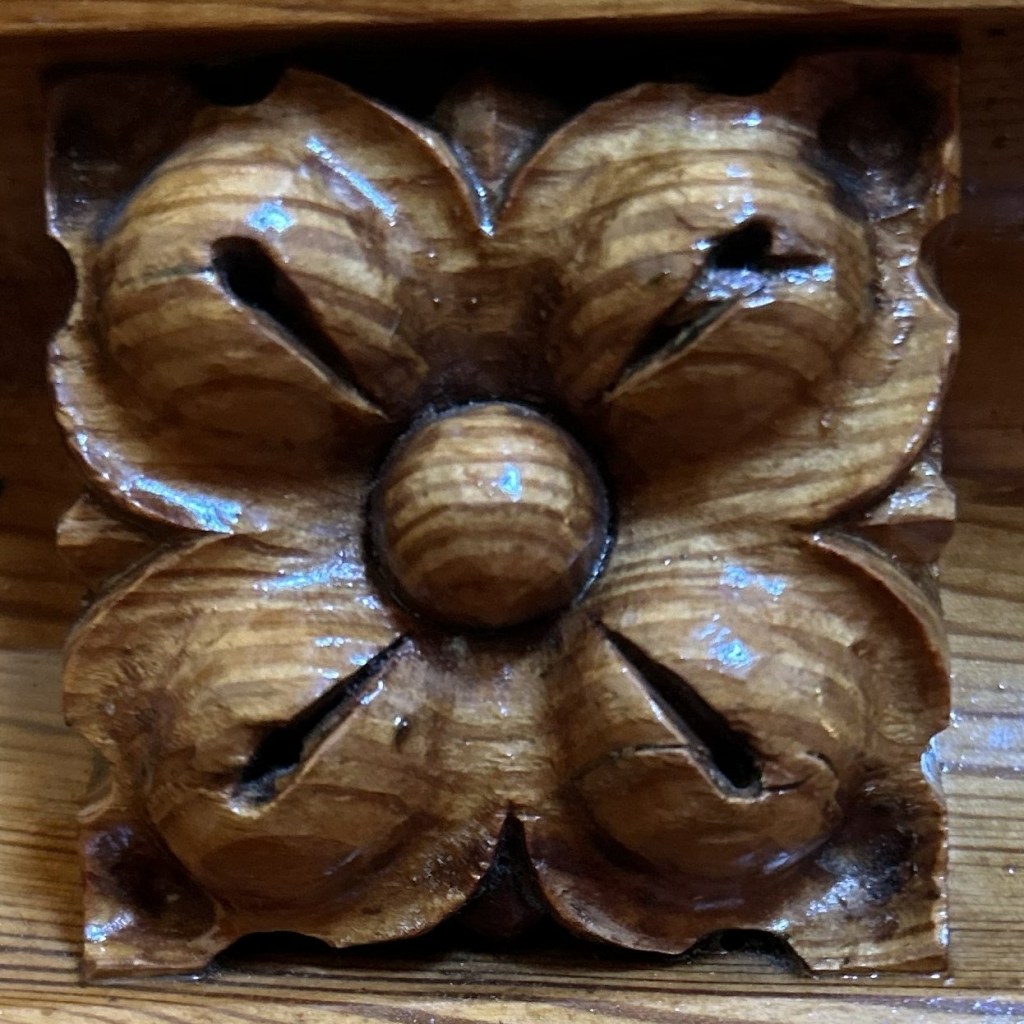
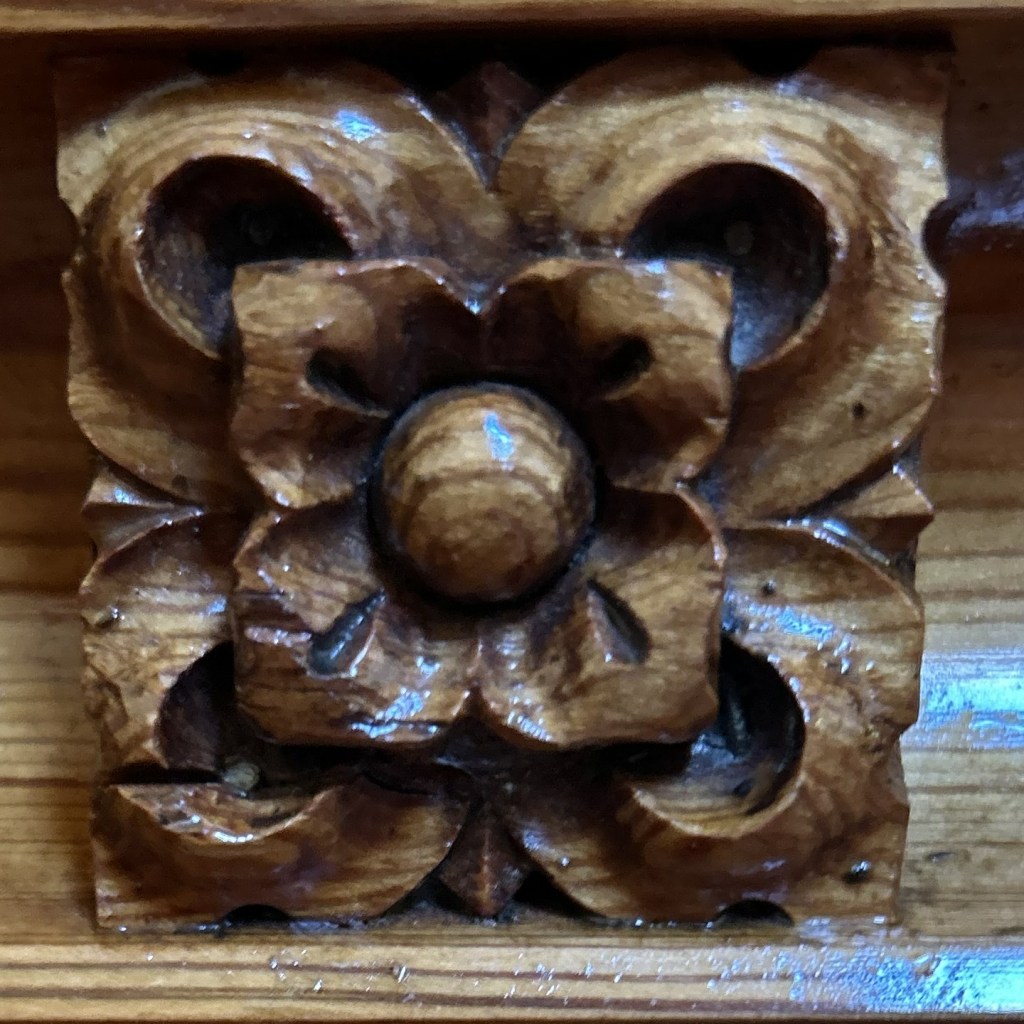
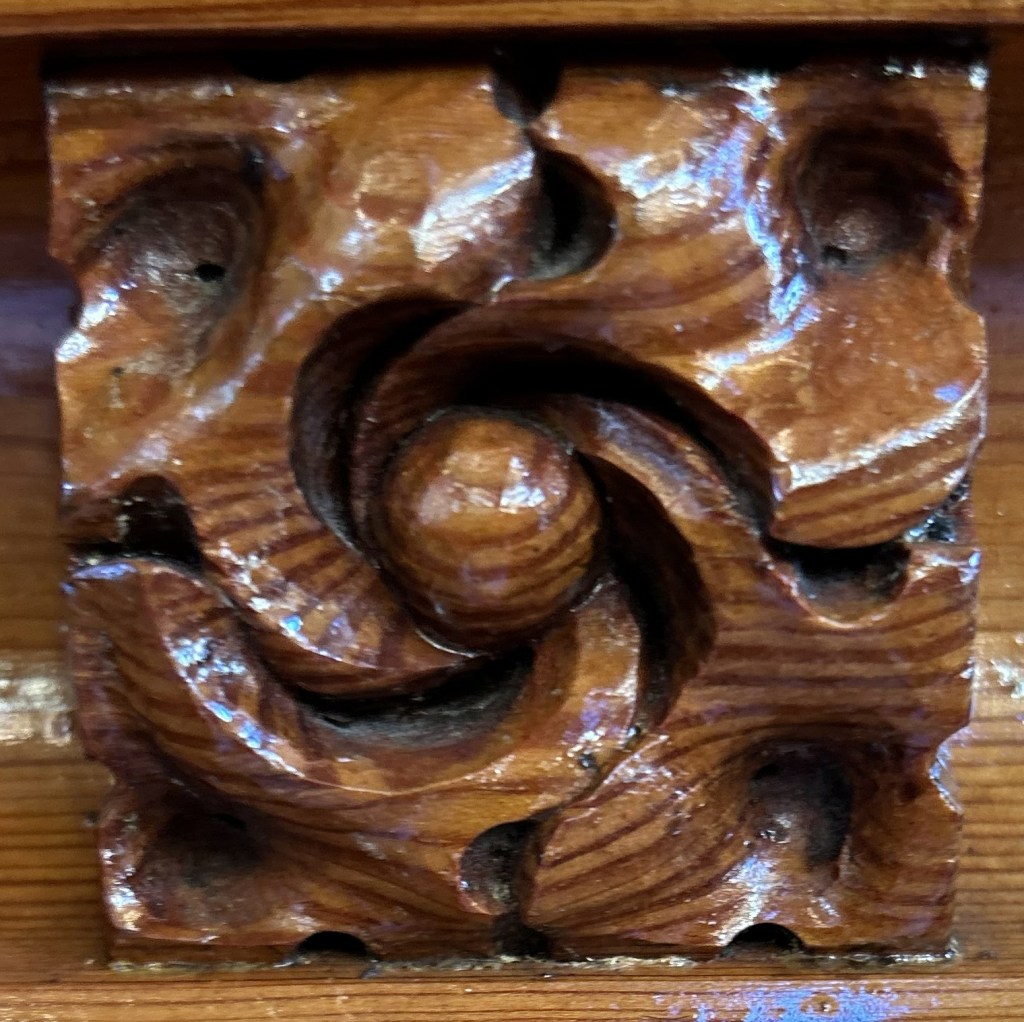
In most of our Sunday services I sit on the front pew where I operate the laptop and overhead projector. Of course this means I‘m also sat almost as close to the pulpit as it’s possible to be. Over the years that I have been doing that I have spent a fair bit of time looking at our pulpit (as well as listening intently to the sermons, of course!). I wonder if you have ever looked at it in any detail… it is a fairly simple design but it has a couple of features that are quite remarkable and which I would guess that most people have never considered in any detail, and maybe some people will have never even noticed. All around the front and sides of our pulpit are wooden panels – probably pine wood – and along the top of those panels are no less than twenty small floral designs, each one cut from a small block, possibly of oak wood, about three inches square. The remarkable thing about them is that each and every one of them is hand-carved and every single one is different to the next. Just below the pulpit we also have a small wooden altar that serves as our communion table. And this also has flowers carved into it. There are just three of those, they are larger than the small flowers on the pulpit and unlike their smaller companions, these are more or less identical to each other.
And I have started to wonder about them, to ask questions about them. So I started to do a bit of research and I think it’s maybe worth reporting what I’ve found and sharing my thoughts on that. So here it is, I hope you enjoy it…
As we all know, our place of worship is an Independent Methodist church. This means that we are in the broad category of churches called ‘non-conformist’. Non-conformist churches are generally those that do not belong to the established mainline churches such as the Church of England or the Roman Catholic church. A typical feature of many non-conformist churches is that their main meeting space is usually a simple ‘barn’ style construction – essentially a simple, rectangular box with a sloping ceiling and roof. The reason for this is that they were (and continue to be) designed in this way as a kind of reaction against the opulence and richness of many Anglican, Catholic or Orthodox churches. Non-conformist churches were designed with few distractions, kept as simple as possible, to ensure that the congregation could focus on “the worship and the word”. And our church certainly follows this pattern, it is a barn-style space with very little embellishment. But that lack of decoration makes me consider the carved flowers on the pulpit even more, because when almost everything else is so simple, they seem to take on a greater kind of significance.
It’s probably also worth us considering one other thing in the way our church is designed and decorated. Our current church building was constructed in 1910 and that was right in the middle of the period when the most popular design style in this country was that of the Arts & Crafts movement. This started in Britain in the 1880s and was broadly an attempt to make things that were “useful, simple and beautiful”. This approach was adopted largely as a reaction against the often useless and elaborate novelty of so many of the items displayed at the famous Great Exhibition of 1851. The years following the Great Exhibition saw many young designers and artists working in new ways, but with an eye very firmly fixed on the natural world. Most famously William Morris took this approach with his fabrics and wallpapers. Although the movement started in the 1850s, it only really took hold by the 1880s but from then it extended pretty much all the way up to the 1920s. So our church building, having been erected in 1910, has a number of features that are very much in keeping with that Arts &Crafts style. It is also a style which was used in furniture and house design, painting, architecture, sculpture and so on. And those lovely little flower carvings on our pulpit, and those larger ones on our altar table absolutely scream “Arts & Crafts” in their style and appearance. I should be clear – our chuch is not built in the Arts & Craft way but it does contain a few features that are most-definitely influenced by that style
In some ways non-conformist churches and the Arts & Crafts movement are natural partners for each other. The leading lights of Arts & Crafts held certain principles very highly and brought them to bear in all of their work. Amongst them were a focus on the important of building community, an emphasis on sincere individual commitment to a task rather than mass production, a love of natural forms such as vines, flowers and so on, which were a reminder of life and fruitfulness. They favoured natural materials which chimed with the non-conformist values of simplicity and honesty. In other words there were numerous reasons why Arts & Crafts contributions to non-conformist churches might have been recognised and valued.
Of course we have no idea who the wood carving artist was who made those pulpit and altar adornments in our own church (although it might be possible to research that of course) and we have no idea what intention he or she had (other than to get paid perhaps) and it might even be impossible to say exactly what flowers they are supposed to be. But we can make some guesswork. You can see photographs of some of the carvings within this article and you may have your own views on which flower species they remind you of… I think I can see roses, maybe forget-me-nots, lilies, St.John’s wort, potentilla… but who knows. Some of them may even be fruit rather than flowers. Are there grapes there? Olives? Acorns? It is entirely possible that they may be all works of imagination rather than being based on real fruit and flowers. The only ones we can name with any certainty are those on the altar tables which are unmistakably lilies.
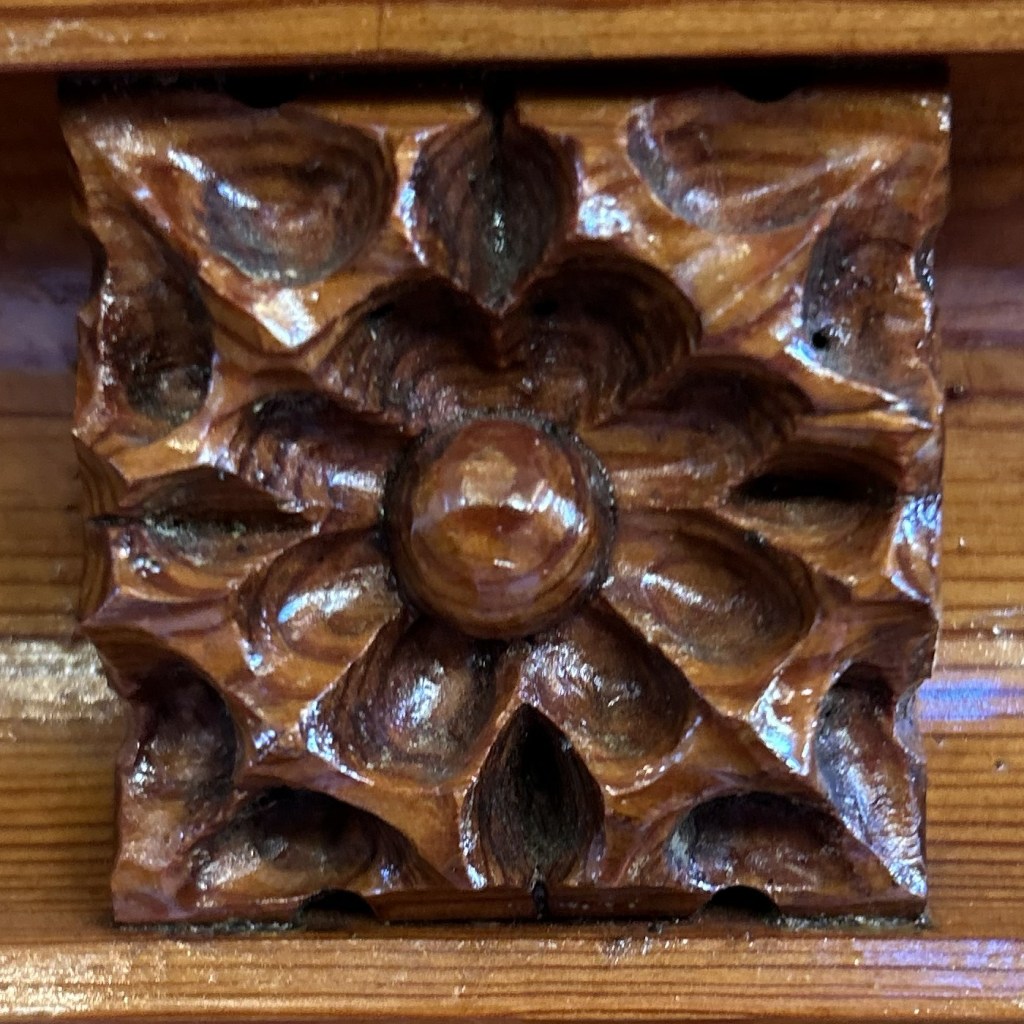
We might also ask “Why flowers? Why fruit?”. Why not more recognisable Christian symbols such as the cross, or a fish, or a dove? Well one possible answer is that the flowers do not represent anything other than simple decoration. But it is also possible that they do tell us something further… in the Victorian and Edwardian eras, flowers were a language all of their own. To give someone a flower was not just to give a floral gift, the flower itself had a meaning and the language of flowers was so well known then that flowers could speak volumes to the recipient. Today we often think of roses as a reminder of love, white lilies as signifying death, but in general we now only hold a very low level of knowledge of that floral language. But back then an iris represented hope, daisies symbolised innocence, ivy stood for faithfulness, thistles for earthly sorrow, poppies for peace and rest, and so on and so forth. Many of those meanings also had a further level of symbolism in the light of the Christian faith too. For example the rose speaks of the blood of Jesus, the passion flower of his suffering, jasmine for the gifts of God, tulips for forgiveness and so on.
As a kind of side note, some of you may remember that in addition to those that we have on the altar table, our old banner also included lilies in its design – another reminder of that floral language so popular back in the late 1800s and early 1900s. I mentioned in the previous paragraph that the lily had a particular association with death but that was not all. It also symbolises innocence, purity, rebirth – and therefore in a Christian context, resurrection.
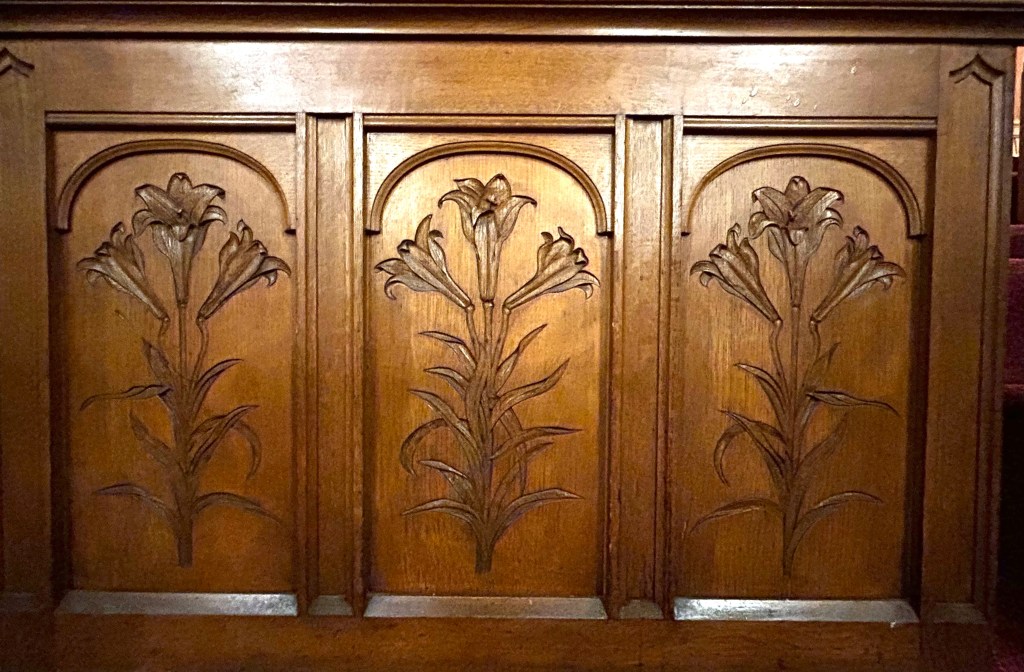
We are now more than a century on from when those small wonders were created for the decoration of our pulpit and altar. We can only wonder if they also have a small sermon of their own to share with us, reminding us perhaps, through that language of flowers, of the death and resurrection of our Lord and Saviour, of the gifts and grace of our loving God. But whether they do tell us a story or not, I’d encourage you to take a minute or two, now and again, to enjoy and appreciate their wondrous, miniature beauty. Created with love, skill and great craftsmanship, a small act of worship in itself.
Memories of a Sunday School Scholar
These memories were provided by James Tobiasen who has been a lifelong member of the church and are focused on his experience as an attendee at the Sunday School as a child in the 1960s and 70s. We’re sure these recollections will resonate with many who also came along to the Sunday School around the same time, or indeed, attended one at another church around the same period.
The period when I was growing up – I was born at the end of 1963 – marks the time when the idea of ‘church’ became less and less prominent in our national life. The cultural revolution of the 1960s, the greed and hedonism of the 1980s perhaps all pushed our national consciousness towards thinking about ourselves rather than spiritual matters. But Fearnhead was still a place where the church played a prominent role in the life of many of the village residents. The only school, on Station Road, a Church of England primary, closely linked to Christ Church Padgate and the only other church was our own, Risley Independent Methodist Church, on Fearnhead Lane. As Fearnhead was still, relatively speaking, a close-knit and self-contained kind of community then, many residents were in the orbit of one or both churches, even if for some people it was only through links with the school. One of the consequences of that was that the Sunday School at Risley was a pretty well attended institution, on a good day attracting thirty, maybe even forty or more children in any of the two sessions, morning and afternoon.
In my early years the Sunday School Superintendent was Miss Jane Cook (“Auntie Janey”), on the surface, a fearsome woman; thin, angular usually wearing her hair in an iron grey Marcel wave, presumably unchanged from the 1920s, and a cardigan in some drab shade of brown or green. Her “rod of iron” presence offset by the altogether more genial assistants – Nellie Turner, Gertie Hughes, May Houghton and others (all know as Auntie…).
The format of the Sunday School session was more or less set in stone: on arrival we would walk to the front and present our ‘Star Card’ to Auntie Gertie – perched like an amiable bank clerk over her high lectern – who would check our name and then, with the kind assistance of an older girl, would print an inky blue star against the relevant Sunday in the card to show that we had been in attendance for either the morning or afternoon session. Little did we know back then but there was a second entry of our attendance made in the actual register which would then be used to count up our appearances for the year in preparation for the annual Prizegiving.
Once all of the children were in the main School Room, they would be seated: the tots on little individual wooden chairs at the front, older children on the benches further back – boys on the left, girls on the right. Once we were all settled into our places there would then be the singing of “choruses”, simple child-friendly songs about Jesus and heavenly aspirations. Most of them, now I think about them again, really a throwback to some Edwardian view of childhood and Christian thinking rather than of any great interest or relevance to the children of the 1960s and 70s. But nonetheless, their words still echo down to me today (“Deep and wide, Deep and wide, there’s a fountain flowing deep and wide”, “Listen to my tale of Jonah and the whale, way down in the middle of the ocean” or “Climb, climb up sunshine mountain”).
Once the singing was finished there would be a run through the Lord’s Prayer and then it was off to our individual classes. Again apart from the very youngest, I think we would be separated into Boys and Girls classes and then further divided by age. Each class with its own teacher. Of course Bible Stories were the basis for all of these lessons but there would also be the occasional excitement of an activity to enliven things: some painting or drawing, maybe the making of a decoration at Christmas or Easter. I do not really remember too much about those classes in all honesty, maybe more so when I was a little older – although now I think about it, given the layout of the church building back then, there was not the room for so many individual classes – perhaps some of them were pretty full!
Once the classes were over we would go back again to the main School Room where there would be a final song or two, a closing prayer and then it was time to go. Some children would, of course, walk home by themselves, some would be collected by parents. This was a great time to be left waiting because now, with a little more freedom, we would revel in playing ‘shove penny’ – two children, one sat at either end of a bench, taking it in turns to push a coin along the groove in the middle of the bench with just the right level of speed and momentum in order to get the penny to drop through the slot at the opponent’s end of the bench. Dropping the penny through the slot counted as a goal. We would play with great competitiveness, hoping against hope that our parents would not appear to collect us before a great victory had been won.
—oooOooo—
The Sunday School year was marked by four great events. The annual Prizegiving, the May Sermons (also known as the Sunday School Anniversary), Walking Day and The Christmas Party. There is already plenty of information on Walking Day elsewhere on this site so here we’ll concentrate on those other three instead.
The first of these was the Prizegiving. The attendances counted up through the weekly register were classified into a first, second or third class prize. With a possible attendance of 104 marks (for a child that attended morning and afternoon Sunday School every week of the year) the bench was set pretty high. But all children were given a prize – usually a book. Each would include a nameplate stuck inside the front cover to confirm who the book had been presented to, what class of prize it was and how many marks had been achieved. Prizegiving was usually pretty early in the year – presumably as soon as all of the previous year’s attendances had been tallied up, the books chosen (usually, I would guess, from the Bible Bookshop on Bridge Street in Warrington), the name plates typed up and matched with the appropriate books.
The next of these special occasion was the May Sermons – so-named, I would assume, because it was a Sunday (in May!) when there were three church services rather than the usual two plus afternoon Sunday School, and because it was a significant day in the church’s calendar there would be a guest speaker who would deliver three separate sermons, one in each of the three services. But because this was also the Sunday School Anniversary, the children of the Sunday School would take centre-stage and participate in all three services, although perhaps only the older children in the evening service. The main focus for the Sunday School scholars though was the afternoon service.
My earliest memory of the Sunday School Anniversary service was of being asked, along with all of the other children, to carry in a bunch of flowers (oh, the embarrassment!) along the left-hand aisle of the church, handing over the blooms at the front so that they could be placed in a huge vertical frame which, by the time all of the children had made their contributions, would be overflowing with a glorious floral display. From there the children would continue to their seats which were in one of two places: the choir stalls or a wooden platform (which would be erected especially for the day between the pulpit and the altar rail).
The children would then go about their performance – singing a series of songs as a choir, interspersed with a number of individual children delivering a ‘recitation’ – a short Bible verse of or simple homily which had been learned by heart. The “Anniversary Practices” which prepared the children for this performance would run on mid-week evenings for a number of weeks in the run-up to the big day.
I think by the time I was seven years old or thereabouts, the practice of the flower parade and display had stopped and also the concept of the May Sermons by around 1980. But the Sunday School Anniversary service celebrations continued for many more years and was still going strong well into the early 2000s.
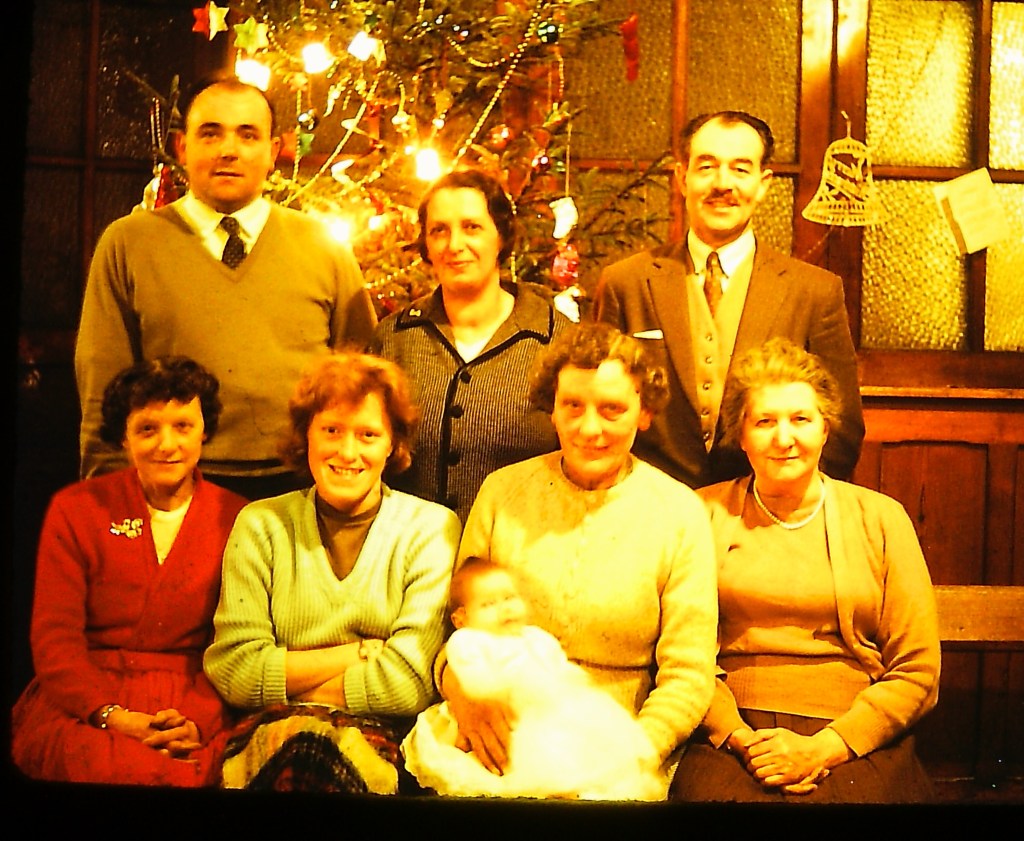
In the photograph above, some of the ‘grown ups’ from the church pose for a photo at the Sunday School Christmas Party in (we think) 1961.
So that brings us to my final memory – the Sunday School Christmas Party. Prizegiving evokes memories of grey February days, and Anniversary of bright May afternoons, but my recollections of the Christmas Party are, as you might expect about dark nights, the warm yellow glow of the ancient lighting, the paper chains, the glistening tree decorations and so much more. As I recall it (and I may have mis-remembered), on arrival we would be sat down for the party tea – all the usual childhood favourites – there may have been savoury stuff but it’s the jelly and cakes that linger in the memory. After the tea there would be games – all the classic childhood favourites – Pass the Parcel, London Bridge is falling down, Farmer, Farmer and many more. When little legs would begin to weary we would be sat down on the floor. Auntie Mary would take to the piano and we would have a sing-song of the many Christmas favourites, Jingle Bells, Rudolph The Red-nosed Reindeer, Away In A Manger and so on. But then! What was that? A banging on the door! Who could it be? The cry would go up: “Let him in, Uncle Ron!” So Uncle Ron would go to the door and with pantomime-ish drama would shout out “Shall I let him in, children?” To be met with a deafening chorus of squeals and appeals. And who should it be at the door but Father Christmas himself…
The impossible, nail-biting wait would then begin. Will my present be first out of the bag? The huge sack of presents would be lugged in and Father Christmas would take his seat in front of all of the children sitting (though now only just managing to sit) on the floor. Aunty Janey (now much more jolly and indulgent than she was in her customary Sunday demeanour) would stand at the side to help with the naming and identifying of the children as their presents were drawn out from the sack. Each child’s gift was drawn out, their name announced and the child, either boldly or timidly (depending on their temperament and age) would come forward to claim their first Christmas present of the season.
With the last of the gifts dispersed (some put to one side for the children who were unable to attend, ready for them when they next attended the Sunday School) there would be one last song and then it was time to go home but only after it was checked and double-checked that Father Christmas had got away safely with no prying eyes looking for the sleigh. The only thing that would make the evening complete was to emerge into the cold dark night to find that snow had started to fall. It didn’t happen very often but when it did… what magic for a young child!
Padgate Walking Day History
Although this is not a direct eye-witness account, the content of this short article is based on archive materials from local newspapers from yesteryear. Many thanks to Sue McWhirther for providing us with access to those archive files.
The exact origins of Padgate Walking Day are not easy to establish. What we do know is that there were only two churches in Padgate during the mid-to-late 1800s. Christ Church Padgate was established in 1838 and the Padgate Methodist/Wesleyan church, which although it had occupied an earlier church building from the 1830s, moved to its current home in 1875. So with just two established churches there was perhaps no great impetus to hold a big organised walk like the one in Warrington town centre, at least not until the area started to develop and the population grew after Padgate railway station was built in the 1870s. But thanks to reports in the then local newspaper (the Examiner) we know that the walk was taking place on an annual basis from around 1903. At that time there were four main groups participating in the procession: the congregation & Sunday School scholars of Christ Church Padgate, the congregation & Sunday School of Padgate Methodist church (often referred to in those early reports as the Wesleyan church), the children from Padgate (now Christ Church) primary school and the staff and children of the ‘Cottage Homes’ – a local orphanage.
In those early days the procession often took place on the Friday before the main Warrington Walking Day. However the day seems to have been quite flexible and was often moved to accommodate the event on days when the weather was more favourable, settling eventually on a Saturday which is where it continues today.
The procession then followed a route that ran along Padgate Lane, changed direction at ‘the finger post’ and then headed towards Blackbrook, eventually stopping at Fearnhead Cross where a service would be held. Often the band of the Industrial School would join the walk and would lead the full gathered crowd in singing the National Anthem at Fearnhead Cross. Teas were provided after the walk and a sports day was usually held after the tea on a local field. Sometimes the end of the day was celebrated with a firework display.
The first year that our own church, Risley Independent Methodist Church, participated, was 1911. This was most likely because the church moved from its old premises on Warrington Road at Risley to its new building – the current chapel – on Fearnhead Lane, in 1910. So 1911 was likely the first year that the walk was held when the church congregation was near enough to the route to be able to participate. In that first year of our participation (1911) a new king (George V) was crowned on June 22nd and to celebrate the coronation, each participating child was given a ‘coronation cup’. Another occasional entertainment in those days was provided by the Cheshire Railway Lines Engineers’ cricket club which would allow free entry for those who took part in the parade.
By 1914 the procession had grown significantly with a church from Woolston, the Salvation Army band and in addition to the ‘sports day’ after-event, the entertainments were supplemented with the first appearance of fairground attractions: shooting galleries, swing-boats, coconut shies and the like.
During the First World War the procession was postponed but in 1919 it restarted and came back bigger than ever with the participants now including a band from the Culcheth Cottage Homes, the Crosfield Scouts, and ‘lurries’ (lorries) which were pulled through the route and which featured ‘tableaux vivants’ – famous scenes from the Bible etc. enacted out by people on the lorries.
Many of the features of those early walks continue today; although some (the sports day, the fireworks, the singing of the National Anthem) have been gradually abandoned over the years. It is nonetheless remarkable that the tradition of this Christian walk of witness continues in today’s secular society. And despite the ravages of the Covid pandemic (when, again, the event was cancelled for a couple of years) the annual procession continues I good health and with a significant number of churches, schools and so on included in the walk. Long may it continue!
Dorothy Swindell (née Dean) – 1920-2019
Dorothy was born and bred in Fearnhead and despite time living away from the area in adulthood, returned to the village for her retirement, with husband Richard, and was a real stalwart of our chuch being the choir master and organist. This piece was written by Dorothy sometime in the 1990s and is really more of a description of the village of Fearnhead and its characters and landmarks from many years ago. It is nonetheless a fascinating insight to a now lost view of the village – and it also mentions our church. We have added a few notes to provide clarifications so that the reader today can perhaps more easily find their way around the places that Dorothy described.
Fearnhead is situated on the main road between Warrington and Leigh
Walking down the main road of Fearnhead village today is vastly different from what it was eighty(1) or so years ago. Then it was a tiny community where everyone knew everyone else, doors were kept wide open all day and neighbours talked over garden gates during the evening while men folk would tend their gardens or allotments. One or two kept a few chickens which provided eggs and, now and then, a Sunday lunch.
There were three main roads meeting at what is known as Fearnhead Cross, where stood the Post Office and village store. Nowadays this old landmark has gone to make way for progress, this being a new road, complete with shopping centre, library, high school, medical centre and community centre occupying pride of place. I don’t think the village of today is half as interesting as it was in times past, as we shall find out. We will take a leisurely stroll around the village, as it was, and meet some of the people and places which made it unique.
Let us start at the Cross and journey down Fearnhead Lane. On each corner stood a shop, one being the newsagents and the other a general store. This was very dark and dismal inside but he sold most things. In later years it was taken over as a wallpaper and paint shop and the daughter of the house-gave piano lessons. At this present time this is the site of the present Post Office and hardware store(2). Next to this shop stood a row of small cottages and here was the barrel works -“tub thumpers” they were called. The cooper made wooden barrels with hoops round them. When this place closed it was opened up again by another member of the Dilliway family on much bigger premises at the far end of the village. Of course, every community must have its pub and ours is the Farmer’s Arms. It is much the same now as it was years ago except for the inside which has been refurbished and bowling mains still take place, the only difference being where once it was all male, now the WI team occupy the green occasionally(3).
Next to the pub was the wire works which hasn’t altered one bit since those far off days(4). Only a handful of men are employed and the same ones have been there for many years. There was a suicide at the back of the wire works. A man drank some acid used for “tinning” -needless to say it was fatal.
Moving on down the lane is a row of cottages – much modernised – but here used to be the tuck shop. The old high school in Warrington had its sports ground at the back of the nurseries and the children used to come to the tuck shop for sweets, 1d bottles of “pop” and 1d cakes. It was kept by a very, very large old lady nicknamed “Peekie” who used to wear a poke bonnet and black cape. The writer of this article especially remembers she had a glass toffee jar with a knob on top and it stood in the window full of hat pins with coloured beads on the end.
The nurseries [5] have gone now, sad to say, but the playing field was made into a golf links (6). This was a favourite place for golfers from miles around until the war came and then it had to go and in its place was built “Canada Hall”, the camp for Canadian air personnel. It soon got to be a familiar sight seeing the airmen and women walking down the lane, although it took some of the old villagers a while to get used to them. During the war a bomb was dropped on the golf course leaving a large crater, which caused quite a number of treks by the locals to view this disaster, but fortunately no-one was hurt, this happening before the building of the “base”.
Fearnhead didn’t have its own school or church, these being in the neighbouring village of Padgate, but there is a chapel which originated as a cottage meeting in the adjoining village of Risley and as numbers grew, this present chapel was built in 1910 at the end of Fearnhead Lane, but still retained its original name of Risley chapel(7). The North Cheshire College of Further Education(8) now stands where Canada Hall used to be.
We are on our way back to the cross now and a small side road takes us to the brick pits. A feature during the winter was the skating – to the accompaniment of an old gramophone. During those far off days we always seemed to get a good thickness of ice on the pits and music and laughter would ring all around. This particular spot has been made into an angler’s paradise and, surrounded by landscaping and children’s play area, is a very pleasant place to walk.
Taking the road to the left from the cross we come to 1 of 3 farms which used to be in the village. It was a familiar sight during the summer months to see “Ernie” with cap back to front bringing the cows along Fearnhead Lane to spend contented days on part of the golf course. They kept the grass cropped but would enjoy the delicacies of our prize lupins which grew in the garden near the footpath. Needless to say, children were blamed for taking these missing lupins to school until the real culprits were caught.
The Royal Airforce camp was built on the boundary between Fearnhead and Padgate and many a new recruit will remember these gates with awe, although the camp itself stretched away along the back of the houses which lined Station Road and Cinnamon Lane, leading on to the Balloon Barrage just beyond the outskirts of the village.
Our village boasted a garage with a couple of pumps which saw to the needs of the few motorists who resided there, and also passing trade, but this has gone now and the telephone exchange stands in its place, which covers a wide area.
A corn merchant stood near the garage and here the miller would grind the corn and then it was transported by lorry to various destinations. This was later turned into a wheelwrights, when the previous owners retired and also served the community as undertaker.
We are back now at the old Post Office so make our way down the third lane, Cinnamon Lane, which makes up the village. Halfway down here was the second farm, but not as prominent a one as that near the cross. When Mr.Ward retired his farm ceased and he built a bungalow near the brick pits where he kept bees, and would go around the neighbouring schools showing the scholars how to extract honey.
The next place of interest is certain to be Fearnhead House. During the time of the black slave trading between the southern states of America and Black Africa, Fearnhead House was occupied by a family who it was said were very instrumental in the campaigning in getting [the slave trade] abolished. The House was rumoured to be haunted, but it wasn’t until the last war that it was proved to be true to the village. The house was taken over by the Air Ministry and the Commanding Officer of Padgate Camp took up residence there. It was Group Captain Insall and his family that established the fact, Mrs Insall having seen the ‘ghost’ which according to her was a black nursemaid holding a child in her arms. Incidentally, the new road leading from the cross, which accommodates the school etc. is called Insall Road after the Group Captain’s family.
No village is complete without a duck pond and our village was no exception. Situated at the end of Cinnamon Lane near to Mathers Farm (Mr Mather being the local JP(9) at that time) and joining up with a country lane, Crab Lane, which skirted the community, it was a peaceful little oasis -a few trees, a rustic seat and of course the ducks. The pond is still there (10) but not nearly so idyllic a setting as it used to be. Leading off down a tree-lined avenue from Crab Lane is Enfield Hall (11) which was haunted also by an old lady who used to sit by one of the windows knitting. Mrs Albinson and members of her family had seen the apparition several times.
Looking back on the old village, children of today are missing out on many things. Swinging on a rickety farm gate as the thresher and binder worked in the field and playing in the stubble gathering wild pansies when it had gone on to its next harvesting; going through the fields to the clear stream to get watercress to bring home for tea; wandering off the other way to another stream with a jam jar and net and catching sticklebacks; paddling after them in the cold water and not daring to go home until your socks were dry. These and many other things come to mind whilst writing about our village.
Notes
- (1) Dorothy wrote this 80 or so years after the events that she recalls but as she was born in 1921 in fact we are reading of the Fearnhead of the 1920s, 30s and 40s.
- (2) In fact the Post Office & hardware shop – managed for many years by the Holbrook family – is now closed also – the premises since then have been a Credit Union and were most recently a tattoo parlour!
- (3) Sadly the bowling green at the Farmers Arms is also now a thing of the past.
- (4) The wire works was on the land that is now occupied by Millport Close.
- (5) The garden nurseries occupied the land where Arran Close can now be found
- (6) The golf course occupied the land between Fearnhead Lane and Crab Lane (roughly where Aviemore Drive and Templeton Drive are now) and was not on the same site as the present day Poulton Park golf course.
- (7) That Risley Chapel is the same church that this website belongs to.
- (8) The North Cheshire College of Further Education is now a campus of the University of Chester
- (9) JP – Justice of the Peace – nowadays more often referred to as magistrates.
- (10) The duck pond mentioned here was just in front of what is now Cinnamon Brow Community Centre on the land between the corner of Cinnamon Lane North and Perth Close. Back then the farm (and the duck pond) belonged to the Warburton family.
- (11) Enfield Hall was demolished many years ago but the ‘tree-lined’ walk that lead to the old house is still there and serves as the entrance to Enfield Park nearest to Perth Close.
Richard Swindell – 1921-2017
Here is an interesting little piece that gives us a flavour of a time in our church that is now beyond living memory. It was written by Richard Swindell who died in 2017 aged 96. Richard had a life that was deeply linked to our church having been born in the building next door to the old chapel, and apart from time in the army, and later spent working and living in Greenock and Llandudno, he remained a lifelong member of our church until his death. He wrote this just a few years before he died and it tells us of his memories of how the Sunday evening services were conducted during his childhood. A few names are mentioned some of which will still be remembered by a few members of our congregation even today. So here it is. A few edits have been made to the original text; in particular some words have been added to help provide clarity – these are shown in the squared brackets like [this].
After [one recent] August morning’s sacramental service, Tom recited a hymn which very few of the congregation knew but for me it brought back old memories. It was 347 in Mission Praise It May Be At Morn When The Sky Is Awakening. I hadn’t heard it for years and it reminds us of our Lord’s return and a prophecy which we are to keep in our mind’s constantly.
It reminded me of the old black I.M. (Independent Methodist) Hymn Book which we used years ago. [It took me back to around] 1931-1933 when as a young boy I attended (under duress) every Sunday evening service with my mother. I thought that [going to church in the] morning and afternoon was quite enough.
Mr.Hughes (Winifred’s grandad) was [then the] longstanding [church] president and, as I look back, a mighty man of God. He would call a meeting after sacrament, made up of testimonies and singing favourite hymns, Mrs Higham (Teddy Higham’s mother) would always start off with that same hymn It May Be At Morn. Mr. Cook, Janey’s dad, would lead with The Old Rugged Cross and my own mother always chose Not All The Blood Of Beasts On Jewish Altars Slain.
Miss Anne Smith (Mrs Higham’s sister) was caretaker [and] always sat on the front row. Her testimony hymn was Happy Day. So with all the protestations to my mother (“I’m tired, can we go home now?”) her reply was always “Sit still and be quiet”. As a reward Miss Smith used to let me put the gas lights out with a long pole.
These memories are now a real blessing to me. But don’t ask what I did yesterday because I can’t remember.
Thanks, Tom, for that one hymn which brought back so many treasured thoughts of eighty years ago, when chapel was full of believers, even if they didn’t show the love and joy which we do today.
Richard Swindell
 Risley Independent Methodist Church